
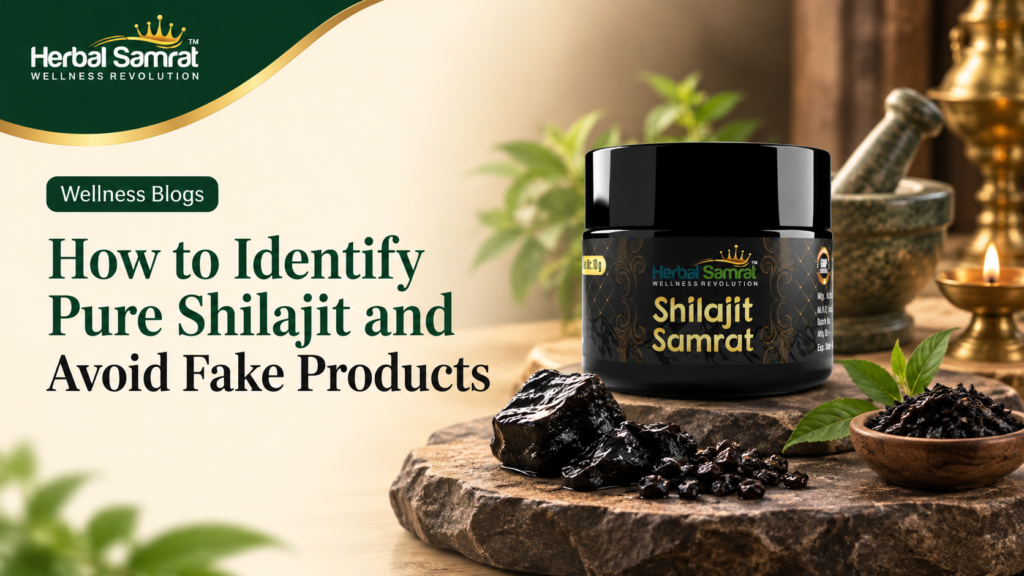
How to Identify Pure Shilajit and Avoid Fake Products
If you’re considering Shilajit for strength, vitality, and sexual health, how do you choose the right product? With several manufacturers offering these health supplements, it’s easy to confuse authentic Shilajit with substandard or fake products in the market. Poor-quality Shilajit may be diluted, improperly purified, or contaminated with unwanted substances.
That’s why, it’s important to know where it comes from, how it looks, and the reputation of the seller. In this guide, we have comprehensively explained how you can identify pure Shilajit and avoid fake products.
Check How Pure Shilajit Looks, Smells and Feels
First, observe the physical characteristics of Shilajit that can provide useful cues, particularly when you buy Shilajit resin. Genuine Shilajit resin is generally dark brown to black and has a thick, tar-like consistency. The texture of Shilajit can change with temperature. It becomes softer and more pliable when warmed and firmer when cooled.
You may also get a distinctive earthy, mineral-like or smoky smell from Shilajit. However, if you find a strong chemical, artificial fragrance or petroleum-like odour, the product may not be genuine.
| What to Check | Features of Genuine Resin | Potential Red Flag |
| Colour | Dark brown to black | Unnatural or unusual colouring |
| Texture | Thick, resin-like consistency | Excessively waxy, rubbery or powdery |
| Warmth | Becomes softer when warmed | Little response to temperature |
| Smell | Earthy or mineral-like | Strong chemical or artificial odour |
5 Simple Ways to Check Shilajit at Home
Although the physical characteristics of Shilajit can help you spot obvious inconsistencies, none of them can prove the purity on their own. The right approach for users is to perform the following tests to check whether the Shilajit they’re using is authentic.
1. The Water Solubility Test
Solubility in water is one of the simplest ways to test Shilajit resin. Place a small amount of resin in warm water and check how it behaves. If the Shilajit is genuine, it should disperse and dissolve substantially. It will produce a dark brown to reddish-brown solution.
However, if you find that the material is significantly waxy, has persistent lumps, or an oily residue, the product should be further scrutinized. At times, it may also leave an insoluble residue.
However, this test doesn’t prove that the Shilajit is safe. Solubility in water cannot identify heavy metals, microbial contamination, or every type of adulterant.
2. Check Its Temperature Response and Pliability
Take a small amount of resin and allow it to warm naturally between your fingers. Genuine resin generally becomes softer and more pliable with warmth. When you cool it, it should become firmer again.
However, if the product behaves like ordinary wax, rubber, or a completely rigid material, it may not be genuine. This test is particularly useful for resin because the same physical assessment may not be a practical approach to test capsules and powders.
3. Examine the Smell and Appearance
Look closely at the resin before consuming it. Genuine Shilajit can have a strong natural aroma, but it should not smell like perfume, solvents, burnt plastic, or other synthetic materials.
Also look for unusual colours, obvious foreign particles, excessive glossiness, or an unnatural texture. With these observations, you can identify a fake product.
4. Use the Heat Test Carefully
The heat or flame test is one of the dependable ways to distinguish pure Shilajit resin from synthetic materials. When you expose a small sample of genuine Shilajit to heat, it may soften or bubble. It should not behave like an easily flammable synthetic material. If the sample burns aggressively or produces a strong odor like petroleum or any chemicals, it’s a warning sign.
5. Perform the Alcohol Test
One of the common ways to check the purity of Shilajit at home is to perform the alcohol test. Place a small amount of Shilajit in alcohol and observe whether it dissolves.
This test is an additional screening method because authentic Shilajit does not behave like many synthetic resins or binders in alcohol. However, the composition and processing of a particular Shilajit extract can result in variations in the result.
What is the most reliable check to ensure the purity of Shilajit?
If you want to assess Shilajit seriously, look out for a Certificate of Analysis (COA). It is much more authentic compared to relying on tests performed at home.
A credible laboratory report should provide information about the specific product or batch and identify the testing laboratory. Depending on the product and testing requirements, look for analysis that cover:
- Lead
- Mercury
- Arsenic
- Cadmium
- Microbial contamination
- Other relevant contaminants
- Product composition or identity where applicable
A seller saying “lab tested” is not the same as providing actual evidence from the laboratory. Ideally, you should be able to review the actual report and identify the batch that was tested and what the results showed. If you are considering products like Shilajit Samrat or the Testobest and Shilajit Combo Pack, check the ingredient details, sourcing information, purification process, and available laboratory reports before making a purchase.
Testing Shilajit Resin vs Powder vs Capsules
The form of Shilajit can affect how easily you can inspect it, but it does not automatically determine purity.
| Form | What to Consider |
| Resin | Easier to inspect for texture, smell and response to temperature |
| Powder | Physical inspection is more difficult, so check the ingredient list and testing information |
| Capsules | Convenient, but the contents cannot be assessed visually without opening them |
Red Flags When Buying Shilajit
Before purchasing, be cautious if a seller:
- Provides no specific information about sourcing
- Cannot provide a relevant COA
- Makes vague claims like “100% pure” without evidence
- Promises instant or guaranteed results
- Uses exaggerated medical claims
- Provides little information about purification
- Has no clear manufacturer or contact details
- Offers an unusually low price without explaining why
- Relies entirely on testimonials instead of quality documentation
Also, fulvic substances are an important component of Shilajit, but a large fulvic acid percentage by itself does not prove that a product is authentic. Be cautious of bold claims like extremely high or near-perfect fulvic acid percentages when the brand cannot furnish any independent laboratory evidence to support them.
Conclusion
There is no single home test that can prove Shilajit is pure. Water solubility, texture, smell and response to temperature can help you identify obvious inconsistencies. But they cannot tell you whether a product contains heavy metals or sophisticated adulterants. If you’re choosing products like Shilajit Samrat or the Testobest and Shilajit Combo Pack for sexual wellness, get them from established brands like Herbal Samrat. Reputed manufacturers prioritise purity and provide adequate quality documentation. Genuine Shilajit products can help you maintain your strength and vitality when used as part of a well-balanced routine.